
Trapped in a Bubble
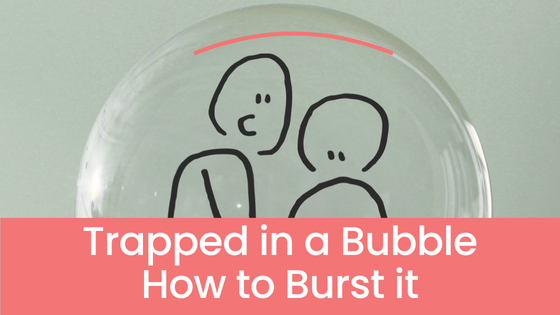
Imagine yourself inside a water bubble.
You can still see the world outside, but not clearly. Shapes blur. Edges soften. Colors shift. Sounds reach you, but they are dull and hollow, filtered through a layer of water. You know there is a whole world beyond that thin membrane, yet you are separated from it in a quiet, almost invisible way.
I remember how we tried to talk underwater as a child. At first, it didn’t work at all. Words dissolved into meaningless noise. So we began to adapt. We learned to read lips. We invented gestures with our hands and arms. We exaggerated our facial expressions. We made up signs and mimicked each other. Conversations became slower, funnier, more creative. There were misunderstandings, of course, but there was also curiosity and laughter.
We didn’t expect communication underwater to be the same as it was above the surface. We knew something had changed, and we adjusted to it.
In adult life, we enter bubbles like this more often than we realize. The difference is that there is no water, no visible boundary, nothing that clearly signals: things are different right now.
And because we can’t see the bubble, we rarely notice how much it shapes what we perceive.
It often happens when we face challenges. You might be in the middle of a demanding task. Struggling in a relationship. Living in an unfamiliar place. Navigating a new language. Dealing with uncertainty or pressure. Something subtle but powerful happens inside you: your focus narrows.
You continue to move through your day. You walk, speak, work, respond. From the outside, everything looks normal. And yet, something feels more difficult than it should. More draining. More exhausting. You assume it’s the circumstances. The situation. The people around you. And yes, circumstances matter.
But at the same time, something is happening inside. You don’t see the bubble forming. You don’t feel it descending. Only years later, sometimes, you look back and realize how tense you were. How tight your world has become.
In the meantime, you cope as best you can. You argue and hustle. You try to fix things. You push yourself harder. Or you do the opposite. You start pleasing others. You avoid uncomfortable tasks. You withdraw. You try to keep everything calm.
These are not weaknesses. They are natural survival strategies. They grow out of fear and the desire to stay safe. But they also change how you see. Your attention collapses inward. You stop seeing the whole landscape. Instead, you begin to look at life through a very specific lens. From inside that lens, everything feels real. Absolute. True.
Your perception and your circumstances merge into a kind of inner space that has its own logic. It becomes an isolated, subjective world, shaped by internal rules and needs. The bubble protects you in some ways. It simplifies things. It cuts out complexity. Sometimes it even cuts out other people.
When you are already struggling, you don’t want more complexity. You already have enough to deal with. So the bubble feels almost helpful.
From the inside, it feels like: this is just how things are. And, quietly, you might add: and I’m right.
This narrowing is driven by the nervous system. In moments of pressure or uncertainty, it seeks safety and control. It does that by reducing input and sharpening focus. This is not a flaw. It’s a deeply human response.
The difficulty begins when we mistake this narrowed perception for reality itself.
Inside this state, thoughts start to loop. They don’t sound like opinions. They sound like observations, and they feel like facts.
Thoughts such as:
“People get bored when they listen to me.”
“I’m new here. I don’t know how things work.”
“Others are faster. Better. More confident.”
Once these thoughts take hold, your attention reorganizes around them.
You stop focusing on what you want to say. Instead, you start focusing on how the other person might be reacting. You watch their face. Are they bored? Are they impatient? Are they still listening? Did they understand? Should you speed up? Simplify? Stop talking?
All of your energy shifts toward observing the other person or the environment, rather than inhabiting your own voice.
And here’s the irony: the more you monitor yourself and others, the less present you become. Your speech slows down, your rhythm falters, and hesitation sets in. You find yourself searching for words, feeling increasingly disconnected from the message you originally wanted to convey.
At the end, you feel exhausted. And your mind quietly concludes: See? I was right. It takes me too long. I’m not good at this. The loop closes.
From that narrow focus, you create more evidence for the original thought. You can only see what you already expect to see. You see what you think. You feel what you think. You act from those feelings. And then you create more of what you already see.
This doesn’t mean you are weak or incapable. It simply shows how deeply perception, emotion, and action are intertwined. When perception narrows, life shrinks with it. From a limited vantage point, exploration becomes difficult. Curiosity fades. You become vigilant. Instead of learning, you defend. Instead of discovering, you confirm.
And yet, the world itself hasn’t become smaller. In fact, it is still complex, layered, and full of possibilities. Complexity can make problem-solving harder, but it also holds more options. When you retreat into the bubble, you don’t only reduce stress — you also reduce your options. Creativity fades. Flexibility softens. The sense of choice becomes distant.
Over time the bubble actually undermines you, even though it feels entirely convincing.
That is one of the most challenging parts: it feels so real. When you are inside it, there is no sense that this might be just one perspective among many. The mind prefers coherence over truth. It wants a consistent story. And once a story is in place, the body aligns with it.
Your breath shortens.
Your muscles tighten.
Your posture changes.
From this physical state alone, it becomes harder to imagine alternatives. Leadership, creativity, and confidence are not only mental qualities. They are bodily experiences. And when the body is tense and guarded, they become harder to access.
This is why you cannot think your way out by simply telling yourself to be positive. The issue isn’t just the content of your thoughts. It’s the state you are in.
Inside the bubble, you gradually lose access to perspective, playfulness, experimentation, and a quiet, embodied sense of confidence. You stop taking small risks that could expand your abilities. Trying something new feels dangerous instead of developmental.
And perhaps the most painful shift is this: you begin to confuse adaptation with identity. You don’t just think, I’m struggling right now. You begin to believe, this is who I am.
So how do you get out?
Not by thinking harder. That often makes the loop spin faster.
The first step is gentle, it’s simply about expanding your awareness. It doesn’t solve or fix anything. It just widens the space in which you operate.
Sometimes that begins with something very simple: acknowledging where you are. Accepting that, right now. Your perception might be shaped by pressure, fear, or uncertainty. Nothing has gone wrong. You are not broken. You are not your thoughts.
Open up to the idea that you might be in a bubble.
Imagine yourself in a water bubble. Suddenly it makes sense that not everything comes through clearly. Sounds are distorted. Movements are slower. Communication needs more effort. And that’s okay.
As children underwater, we didn’t expect things to work the same way. Instead we adapted, became creative, curious, experimental, and laughed at the misunderstandings.
You can do something similar now. Get to know your bubble. What creates it? How does it feel in your body? How do you behave when you are inside it? If someone could observe you from the outside, what might they notice?
You are not wrong. Others are not wrong. You are simply not seeing everything at the moment. And that is not a failure. It’s a human condition.
Even that small realization can create a tiny crack.
Rather than tightening your focus even more, try reconnecting with your body. Gently bring your attention back to your breath. Slow down your exhalation. Notice your feet grounded on the floor. Open your chest slightly, and soften your jaw.
Use your senses. Notice the space around you. The sounds. The light. The temperature. Let yourself pause for a moment inside the environment you are in.
These are not cosmetic gestures. They signal safety to the nervous system. And safety restores access to choice.
As the bubble loosens, something shifts: the world feels a little larger again. You start noticing new options, sensing space where there once was only pressure. This makes you less absorbed and more capable of responding to it.
You don’t suddenly become fearless or perfect. But you regain access to curiosity, creativity, self-leadership and self-trust. And from there, new stories become possible — not because you force them into existence, but because you finally have enough space to see them.
The loop doesn’t end because you conquered it. It ends because you step, gently, beyond its walls. And often, that step is much smaller, and much kinder, than you ever imagined.